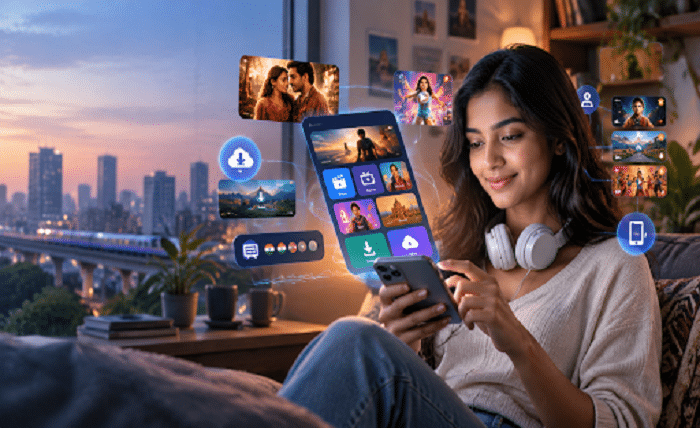
Look around a crowded train or a bustling cafe anywhere in India today, and you’ll notice a quiet revolution in how people spend their downtime. The living room television is no longer the center of the action. Instead, the smartphone has become a 24/7 personal theater. We scroll through short clips over morning tea, catch up on downloaded episodes during the commute, and stream regional blockbusters before bed.
What makes this seamless experience possible isn’t just faster internet—it’s a growing ecosystem of specialized digital tools. Quick browser-based downloaders let us grab fleeting content on the fly, while robust streaming apps bring massive libraries straight to our screens. Together, they are completely rewriting the rules of mobile entertainment.
The Smartphone as the Ultimate Entertainment Hub
The most significant shift isn’t just the sheer volume of online media, but our ability to access radically different formats from a single device. Social platforms offer bite-sized videos and trending clips for quick breaks, while streaming services cater to longer sessions like movies, web series, and live sports.
Entertainment is no longer tethered to a TV schedule or a specific room in the house. A user might discover an interesting video while traveling, save it for later, and then settle into a movie once they get home. Each activity serves a different mood, yet everything happens within the same mobile ecosystem. For Android users especially, this has fueled the rise of specialized apps tailored to exactly how and when we want to watch.
Download Tools Bring Flexibility to Fleeting Content
Social media moves fast. A captivating video or image can vanish from a feed in minutes, buried under an avalanche of new posts.
This fleeting nature has driven demand for simple, browser-based download tools. Instead of relying on easily forgotten bookmarks, users can quickly save permissible content for offline viewing. This is incredibly practical for keeping reference materials, tutorials, recipes, or creative inspiration on hand.
Furthermore, browser-based tools require virtually no setup. Users can simply open a website, paste a supported link, and save the file without installing heavy applications. In a mobile-first market, eliminating unnecessary steps dramatically improves the user experience.
Why Convenience is King on Mobile
While desktop users might comfortably juggle a dozen open tabs, mobile users demand speed and efficiency. Every extra screen, registration prompt, or complex menu adds friction.
Consequently, the most successful mobile tools prioritize straightforward interactions, allowing users to find what they need, tap a few times, and move on. This same expectation applies to streaming apps. Having a massive content library is no longer enough. Intuitive navigation, smart search functions, easy language selection, and smooth playback controls are what truly determine an app’s everyday utility.
Streaming Apps Redefine Mobile Entertainment
While download tools solve the need for quick content retention, streaming platforms cater to long-form entertainment. Historically, watching a movie or TV show required a television, a cable connection, or a trip to the cinema. Streaming has completely decoupled entertainment from these traditional formats, turning any compatible Android device into a portable theater.
Since viewing habits vary wildly—from squeezing in a 20-minute episode on a lunch break to binge-watching a full series at night—applications like Castle have evolved far beyond simple digital catalogs. They now emphasize personalized recommendations, multi-language support, subtitles, and interfaces optimized for smaller screens. The result is a highly personalized viewing experience where the user dictates exactly what, when, and how they watch.
Language Diversity is Shaping the Streaming Landscape
A defining characteristic of the Indian market is its immense linguistic diversity. While Hindi and English content draw massive audiences, regional languages like Telugu, Tamil, Malayalam, Kannada, Bengali, Marathi, and Punjabi boast their own thriving entertainment ecosystems.
South Indian cinema, for instance, routinely shatters viewership records outside its native states, and regional web series have made audiences eager to explore content from across the country.
For streaming platforms, this diversity is both an opportunity and a hurdle. Dumping thousands of titles into an app doesn’t make it better if users have to sift through irrelevant content. Features like regional categories, robust search tools, and culturally aware recommendation engines are essential to making massive libraries feel curated and relevant to the individual.
Different Tools for Different Needs
It is tempting to view download tools and streaming apps as rivals, but they actually serve entirely different purposes. A lightweight web tool is perfect for quickly grabbing a specific piece of media, whereas a streaming app is a destination for browsing and immersing oneself in a broader entertainment catalog.
Consider a typical day: a user might use an online tool to save a useful tutorial they scrolled past on social media. Later that evening, they might open a streaming app to relax with a full-length film. The first task requires speed; the second demands discovery, organization, and a comfortable viewing interface. Together, they form a complementary mobile entertainment ecosystem.
The Push Toward Personalization
The next frontier in mobile entertainment is hyper-relevance. Users don’t want to endlessly scroll; they want the app to do the heavy lifting. Language filters, viewing history-based recommendations, and “not interested” toggles put the user in control of their home screen.
Several Android entertainment platforms are leaning heavily into this trend. The Castle App, for example, is built around seamless access to a wide variety of entertainment while prioritizing a smooth, mobile-centric browsing experience. Ultimately, the success of these platforms isn’t measured by the sheer size of their catalogs, but by how quickly they can guide a user from opening the app to hitting play on something they’ll love. In India, delivering this means offering deeply localized experiences rather than a one-size-fits-all interface.
Bridging the Gap Between Online and Offline
Although reliable mobile networks have made streaming highly practical, connectivity in India still fluctuates based on location and data availability. True flexibility means accommodating these realities.
Users might prefer high-definition streaming on a stable connection, but rely on authorized downloaded content during a train journey with spotty reception. The future isn’t strictly “stream everything.” Instead, it’s a hybrid model. Streaming provides instant access to endless libraries, while legitimate offline viewing features give users control over their media when connectivity drops. The best platforms adapt to the user’s environment rather than forcing a single viewing model.
The Growing Importance of Simplicity
As our digital lives become more crowded, simplicity becomes a premium feature. People are constantly jumping between messaging apps, social media, mobile games, and shopping platforms; they have little patience for a cluttered, confusing entertainment app.
The golden rule for modern mobile products is to minimize the friction between intention and action. For a download tool, this means an intuitive process right from the first tap. For a streaming platform, it means clean categories, accurate search, smart recommendations, and accessible playback controls. The end goal is simple: less time navigating, more time watching.
The Future of Mobile Entertainment is Personal
India’s mobile entertainment market will likely never consolidate into a single “super app” that does everything. Instead, users will continue curating their own toolkits. Social platforms will drive discovery, browser tools will handle utility tasks, and streaming apps will offer immersive viewing.
At the same time, these distinct services will become increasingly personalized. Granular language preferences, regional discovery features, and smarter algorithms will make platforms feel tailor-made for the individual. In a country where two people living in different regions might have entirely different linguistic and cultural tastes, this personalization is non-negotiable.
A New Era of Flexible Viewing
Mobile entertainment in India has broken free from rigid formats. A user can seamlessly transition from a viral social media clip, to a browser utility, to an offline video, to a full-length movie—all on a single device.
Download tools and streaming apps represent different facets of this ecosystem, but both point to the same underlying truth: Indian consumers demand total control over how, when, and where they consume digital content. As smartphones become even more entrenched in daily life, the platforms that embrace this flexibility will win out. The future isn’t just about offering more content; it’s about making that content effortlessly accessible, highly personalized, and perfectly suited to the rhythm of the user’s day.