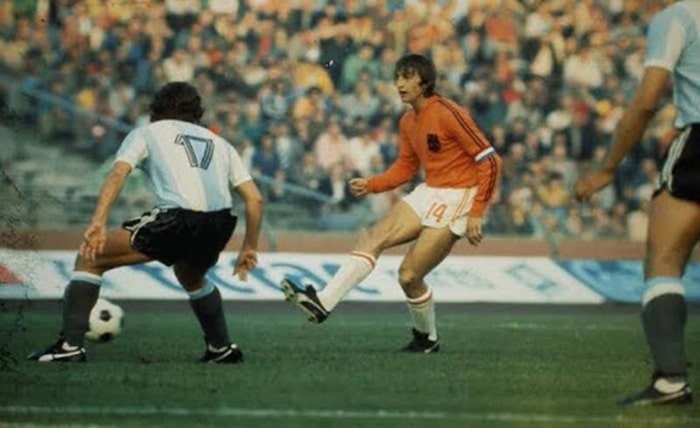
Total Football tactics are one of the most influential tactical philosophies in the history of football, closely associated with Dutch football, coach Rinus Michels, and legend Johan Cruyff. Instead of forcing players to remain fixed in specific positions, this philosophy emphasizes movement, positional rotation, pressing, and mutual support. When watching xoilac tivi, fans can recognize that many modern teams still inherit these core principles to control matches.
Overview of Total Football Tactics
In essence, Total Football is not a fixed tactical formation but a method of organizing a team based on flexibility. In this system, players can leave their initial positions to exploit space, but teammates must immediately move to maintain the overall structure. This principle of positional compensation allows the team to remain balanced even as individuals constantly change their areas of activity.
Overview of Total Football Tactics
The Netherlands national team at the 1974 World Cup was a classic example of this philosophy under Rinus Michels. FIFA highlighted the Dutch team’s continuous movement, spatial control, and proactive pressing, with Johan Cruyff as the central figure. When fans check kết quả bóng đá on Xoilac TV, they often focus on the final score, but to understand the quality of a system, it is also necessary to observe how a team creates and controls space.
The distinctive feature of Total Football lies in its demand for players to possess a comprehensive tactical understanding. A defender needs to know how to build up play, a midfielder must be capable of defending, while forwards are also expected to actively apply pressure. Therefore, players do not simply perform an individual task but become flexible components within the collective structure.
Core Principles of Total Football
Continuous Positional Rotation
One of the most prominent characteristics of Total Football tactics is the ability to rotate positions purposefully. When a forward drops deep, a midfielder can move forward to occupy the vacant space; when a full-back advances, another player must shift to maintain defensive coverage. These changes happen continuously but remain within the tactical framework established through training.
Xôi Lạc TV recognizes that the purpose of positional rotation is not to create chaos but to make it difficult for the opposition defense to maintain its marking structure. If a center-back steps forward to follow a striker, the space behind can immediately be exploited. If the defender does not follow, the striker can drop back to receive the ball and organize an attack.
Core Principles of Total Football
Johan Cruyff was a clear example of this approach. He could start in a central position but constantly move toward either flank or drop into midfield, thereby stretching the defense and creating space for his teammates. Viewers of xoilac tivi analyzing matches that apply similar ideas will see that the position shown on the team lineup does not fully reflect a player’s actual position at every moment.
Controlling Space
Many people believe that Total Football simply means keeping possession of the ball for long periods, but its deeper essence lies in controlling space. A team must understand which areas need to be occupied, which spaces should be deliberately left open, and when the structure should change to create an advantage.
When in possession, players constantly create passing triangles and maintain appropriate distances. When possession is lost, the team immediately reduces the space around the opponent to limit their ability to build attacks. This approach creates continuity between attacking and defensive phases.
This is also why statistics showing kết quả bóng đá cannot fully reflect tactical quality. A team may control the match for most of the game but score only once, while the opponent may have less possession but make effective use of a single counter-attacking opportunity. The value of a system lies in its ability to create consistent advantages throughout the match.
Proactive Pressing
According to Xoilac Live, pressing is a key component of Total Football. Immediately after losing possession, players close to the ball must apply pressure so that the opponent does not have enough time to assess the situation and execute an accurate pass. When performed collectively, pressing can help a team regain possession high up the pitch.
The defensive line is often pushed higher to reduce the distance between the lines. This allows the team to maintain a compact shape and create continuous pressure. However, a high defensive line also means that the space behind the defense becomes larger, requiring players to read situations with great accuracy.
From the Netherlands in 1974 to Modern Football
For those who regularly watch live matches on Xôi Lạc Z, the Netherlands national team at the 1974 World Cup is the most famous symbol of Total Football. Under Rinus Michels, the Netherlands reached the final with a highly proactive style, defeating Argentina 4-0 in the group stage and Brazil 2-0 in the semi-final before losing 2-1 to West Germany in the final. FIFA has recognized the Dutch team of that era as one of the sides that had a major influence on football tactical thinking.
From the Netherlands in 1974 to Modern Football
Although they did not win the World Cup, the Netherlands created a distinctive Total Football tactical legacy. Cruyff later continued to develop and transmit many Total Football ideas during his work at Barcelona, laying the foundations for a philosophy centered on possession and spatial control that strongly influenced subsequent generations.
Modern football does not copy the Dutch school of thought exactly but has inherited many of its principles. According to news from Xoilac Link, high pressing, inverted full-backs, deep-lying forwards, ball-playing goalkeepers, and positional rotation all reflect the development of Total Football thinking.
When watching xoilac tivi, fans can observe these modern variations through the way teams create numerical superiority in specific areas, quickly switch the direction of attack, and immediately organize counter-pressing after losing possession.
Conclusion
In summary, Total Football tactics are a philosophy that places flexibility, spatial control, positional rotation, and collective coordination at the center of play. From the Netherlands national team in 1974 to modern tactical variations, these ideas continue to have a significant influence on how teams organize both attacking and defensive phases. Fans can follow Xoilac Tivi to observe directly how these principles are applied on the pitch, while also referring to kết quả bóng đá to evaluate their effectiveness after each match.