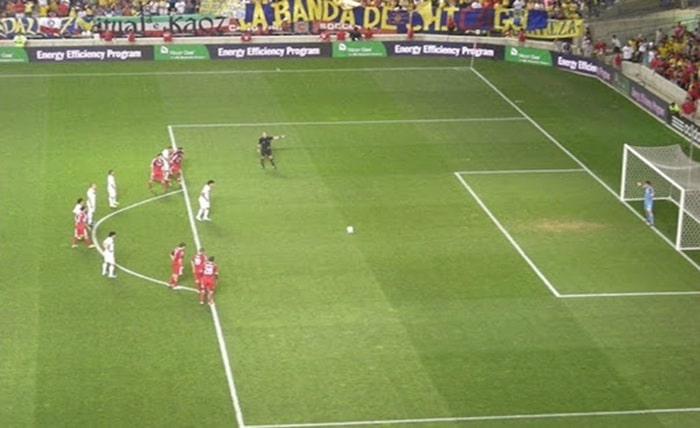
In the world’s most popular sport, few moments create as much breathless tension as a penalty kick. One shot can turn a player into a national hero, but it can also plunge them into the depths of disappointment. Even after watching hundreds of top-level matches, many football fans still wonder how many meters a penalty kick is, what the international standard is, and why this distance has become a decisive line between triumph and despair at the penalty spot. Let’s take a closer look at everything fascinating surrounding this fateful kick.
How many meters is a penalty kick? The standard distance under FIFA rules
According to the official Laws of the Game issued by the International Football Association Board (IFAB) and FIFA, the distance from the penalty mark to the goal line is exactly 11 meters (equivalent to 12 yards or 36 feet in the imperial measurement system).
Because of this distance, Vietnamese football fans and media commonly refer to a penalty kick as a “shot from the 11-meter spot.”
The 11-meter spot – one of the most dramatic points of no return on the green pitch.
The history behind the 11-meter spot
The penalty kick rule was first proposed in 1890 by William McCrum, a Northern Irish goalkeeper and businessman. Initially, penalty kicks could be taken from any point 12 yards away from the goal. By 1902, the fixed penalty mark 11 meters from the goal was officially introduced and has remained unchanged to this day.
Strict regulations when taking a penalty kick
A penalty kick is not simply a matter of placing the ball down and taking a shot. To ensure maximum fairness, referees and players must strictly follow the following rules:
- Goalkeeper’s position: At the moment the kicker strikes the ball, the defending goalkeeper must have at least part of one foot touching or level with the goal line. The goalkeeper is not allowed to move forward before the ball is kicked.
- Position of other players: Except for the kicker and the opposing goalkeeper, all other players from both teams must remain outside the penalty area (16.50m), outside the penalty arc, and at least 9.15m (10 yards) away from the penalty mark.
- Run-up: The kicker is allowed to feint or vary their pace during the run-up. However, once the run-up is complete and they are preparing to swing their leg and strike the ball, they are strictly prohibited from stopping completely to perform a feint as if they were about to shoot.
The correct ball placement at the penalty spot according to FIFA regulations.
Why has the 11-meter distance become such a nerve-racking “psychological battle”?
Sports experts consider the 11-meter distance to provide a near-perfect balance between the kicker and the goalkeeper, creating extremely intense mental battles.
The advantage lies with the kicker
A well-struck penalty from professional players typically reaches an average speed of 80 to 110 km/h. At this speed, the ball takes only around 0.2 to 0.3 seconds to travel from the 11-meter spot into the net. Meanwhile, the natural reaction time of an elite goalkeeper takes at least 0.5 seconds to judge the shot and dive. This means the goalkeeper almost has to “guess” the direction of the shot before the ball even leaves the player’s foot.
Immense pressure on the player’s feet
Despite having a clear advantage in terms of reaction time and shooting angles, the kicker faces tremendous psychological pressure. Even a slight mental burden can cause the shot to fly over the crossbar or miss the post in heartbreaking fashion.
Unique penalty-kick styles in modern football
To overcome clever goalkeepers, many superstars have developed distinctive penalty-taking techniques of their own:
- The Panenka: The player gently chips the ball into the center of the goal, beating the goalkeeper after they have already committed themselves by diving to one side.
- The hop-step technique: The player makes a small hop just before striking the ball to observe the goalkeeper’s movement before shooting in the opposite direction, as seen with players such as Jorginho and Bruno Fernandes.
- The powerful strike: The player puts maximum power behind the shot and drives the ball into the upper corner of the goal, leaving the goalkeeper with virtually no chance even if they guess the correct direction.
The breathless battle of wits between the kicker and goalkeeper at the 11-meter spot.
Stay updated with the excitement of football every day
Nerve-racking penalty shootouts from the 11-meter spot always deliver some of the most explosive emotions for viewers. To avoid missing the results of dramatic matches decided by tense penalty shootouts the previous night, checking kqbd dem qua has become a useful habit for fans who want to quickly keep track of the situation across competitions.
Alongside score updates, the demand for watching these intense battles of wits from the 11-meter spot live with smooth image quality is also significant. Today, watching tructiepbongda has become extremely convenient thanks to the support of reputable sports media platforms.
Among them, the Xoilac 365 brand has long been a familiar destination for football fans. The website provides sharp streams, high transmission speeds, and immersive audio quality, allowing viewers to experience every tense moment at the penalty spot. With Xôi Lạc 365, you can easily immerse yourself in the atmosphere of top-level football every day.
Conclusion
Understanding how many meters a penalty kick is, along with the rules surrounding the 11-meter spot, will help you fully appreciate the drama of the world’s most popular sport. That short distance of 11 meters is not merely a measurement of length; it is an arena where the composure, class, and presence of the world’s top stars are put on full display.